

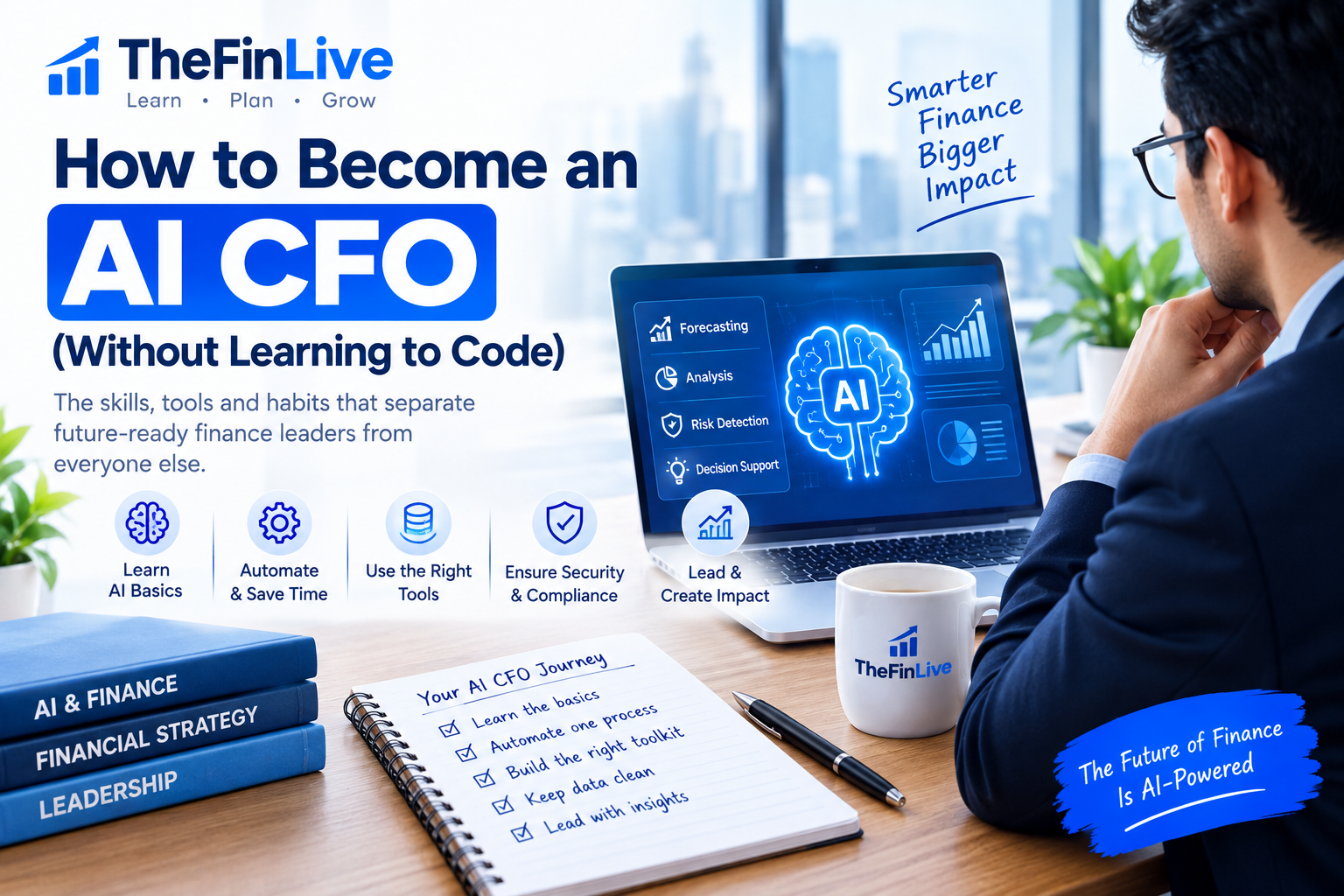
How to Become an AI CFO
Last quarter, a CFO I know spent three days building a cash flow forecast. Her competitor did the same thing in about forty minutes, then used the other two and a half days to renegotiate supplier terms.
That’s the gap. It isn’t talent or budget. It’s one CFO using AI and the other one not. Here’s the good news: becoming an AI CFO doesn’t mean becoming a data scientist. It means becoming a finance leader who knows where AI helps, where it doesn’t, and how to steer it. Here’s how to get there.
What Is an AI CFO, Really?
An AI CFO isn’t a robot in a suit. It’s a chief financial officer who uses AI to forecast faster, spot risks earlier, and make decisions with better information, while keeping human judgment firmly in charge. Think of it as the difference between a calculator and a co-pilot. The calculator answers what you ask. The co-pilot notices what you missed.
Step 1: Get Comfortable With the Basics
You don’t need to build models, but you do need to speak the language. Learn what these mean in plain English:
● Machine learning: software that finds patterns in your data and improves over time
● Generative AI: tools like ChatGPT and Claude that create text, summaries, and analysis
● Predictive analytics: using past data to estimate what happens next
Spend 20 minutes a day on this for a month. That’s it.
Step 2: Start With One Painful Process
Don’t try to transform finance overnight. Pick the task your team dreads most. Usually it’s one of these:
● Month-end close
● Invoice matching and accounts payable
● Variance analysis commentary
● Cash flow forecasting
Automate one. Measure the hours saved. Then move to the next. Small wins build trust, and trust gets you budget.
Step 3: Learn to Prompt Like a Finance Pro
The quality of what you get from AI depends on what you put in. Compare these two:
● “Analyze our expenses.”
● “Here’s our Q3 expense data. Flag anything that grew more than 15% versus Q2, group it by department, and suggest three questions I should ask each budget owner.”
Be specific. Give context. Ask for the format you want. This one skill will save you hundreds of hours.
Step 4: Fix Your Data First
Here’s the unglamorous truth: AI is only as good as the data you feed it. Messy spreadsheets, duplicate records, and inconsistent categories will give you confident-sounding nonsense. Before you invest in fancy tools, clean up your chart of accounts, standardize your naming, and decide who owns data quality. Boring? Yes. Essential? Absolutely.
Step 5: Build a Toolkit (Not a Tool Graveyard)
You don’t need twenty platforms. Start with a small stack covering:
● Forecasting and planning: Anaplan, Pigment, or Cube
● Automation and AP: Ramp, Bill.com, or similar
● Analysis and reporting: an AI assistant plus your existing BI tool
Test each with a real problem before you commit.
Step 6: Protect Trust, Security, and Compliance
CFOs are the guardians of trust, and that doesn’t change with AI. Set clear rules early:
● Never paste sensitive financial data into public AI tools
● Always have a human review anything going to auditors, boards, or investors
● Document how AI-assisted decisions are made
The CFO who ignores this becomes a cautionary tale.
Step 7: Shift From Reporting to Advising
This is the real prize. When AI handles the number-crunching, you’re free to do what only humans can: tell the story behind the numbers, challenge assumptions, and guide strategy. The best AI CFOs don’t say “here’s what happened.” They say “here’s what’s coming, and here’s what we should do about it.”
Common Mistakes to Avoid
● Buying tools before defining the problem
● Trusting outputs without checking them ● Leaving your team out of the conversation (they’ll fear replacement unless you show them the upside)
● Waiting for the “perfect” moment to start
The Bottom Line
You don’t become an AI CFO by reading about AI. You become one by trying it on a real task this week, learning from it, and doing it again.
Start small. Stay curious. Keep your judgment sharp.
The finance leaders who win in the next decade won’t be the ones who know the most about AI. They’ll be the ones who started first.